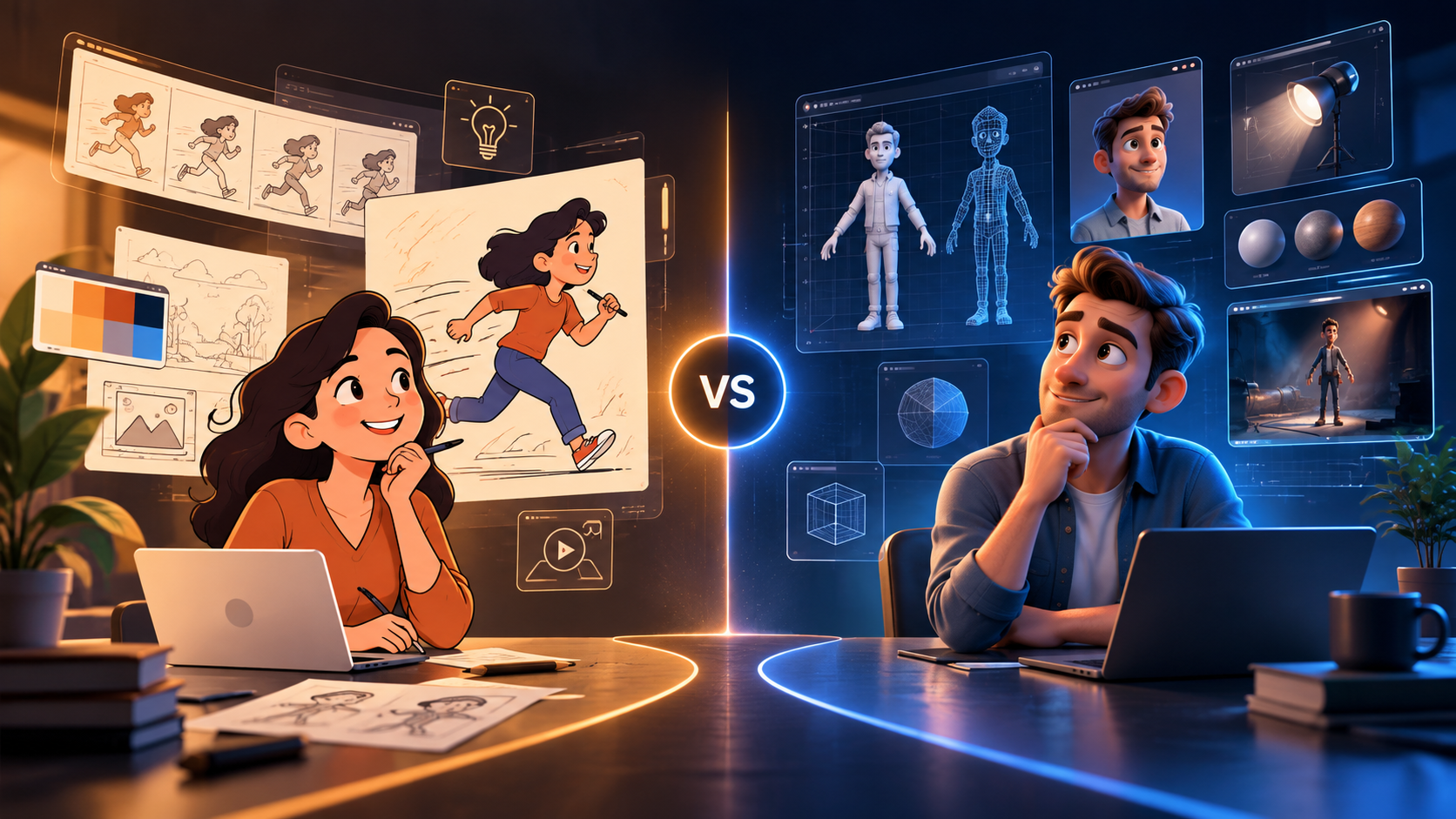


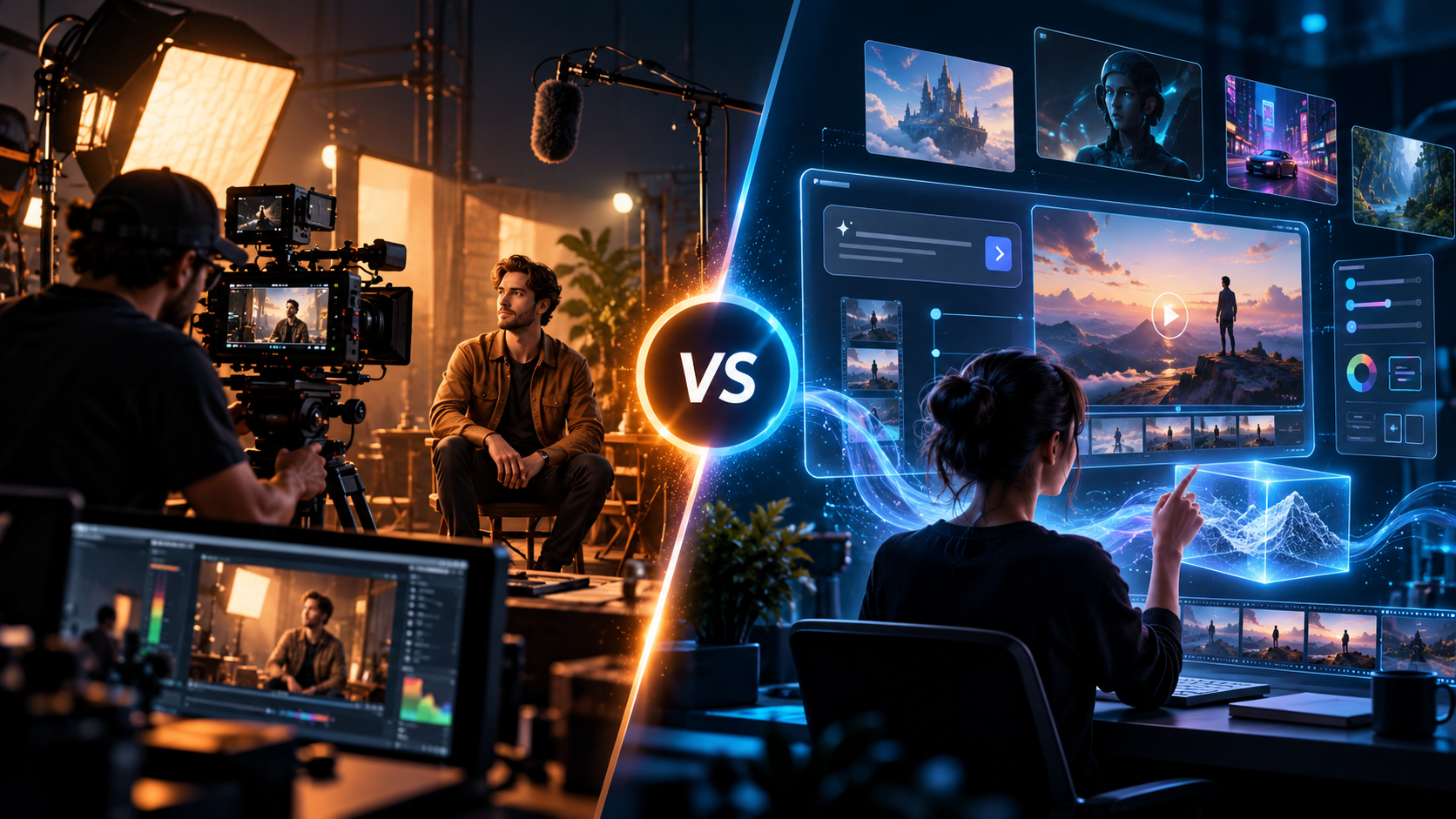
AI vs Traditional Live-Action Shooting: Which to Choose for a Commercial
05.10.2026
Abstract
AI video refers to commercials created using neural networks: scenes, characters, and locations are generated based on text prompts and references, without a camera or production crew.
Traditional shooting provides full control over the shot and exact product accuracy, but requires more time and budget. Generation is faster and more cost-effective, but falls short in realism and predictability of the final output.
In practice, the choice is rarely binary: most commercial projects today are produced in a hybrid format, combining live-action footage, AI generation, and motion graphics.
In this article, we analyze which tasks suit each approach best, what factors make up the budget, and how to choose the right format for your specific objective.
The request “can we make this using AI?” has become standard during the briefing stage. Clients see high-quality generated videos online and expect the same outcome for less money and in a shorter timeframe.
Partially, this is true. Neural networks indeed handle certain tasks faster and cheaper than a camera. However, there are formats where generation still falls behind, and it is better to realize this before launch rather than after project delivery.
What is AI Video in Simple Terms
A camera captures reality. You set up the lighting, direct the actor, and work with the product – and the frame captures your exact product with all its fine details.
A neural network does not capture reality; it builds it from scratch. It constructs images based on millions of third-party frames, relying on your prompt and references. The result can be indistinguishable from actual filming, or it might produce a skewed label or text that only vaguely resembles real typography.
All other practical differences between the two approaches stem directly from this fundamental distinction.
How AI Video Fundamentally Differs from Traditional Live-Action Filming
| Parameter | Traditional Live-Action | AI Video |
| Production timeline | From 2 weeks including pre-production | From a few business days |
| Product accuracy in frame | Absolute | Approximate, requires cleanup |
| Number of variations | Limited by shoot schedule | Virtually unlimited |
| Post-delivery revisions | Requires reshooting | Re-generating the scene |
| Genuine human emotion | Strong suit | Weak suit |
When to Choose AI Video
Generation offers a tangible advantage in several scenarios:
- there is nothing physical to shoot – the product is in development, the service is intangible, or the object exists only in blueprints;
- a shot is disproportionately expensive – aerial panoramas, underwater footage, or internal mechanical views;
- you need multiple ad variations to test marketing hypotheses;
- the video is released in several languages with different voiceovers.
The most practical use case is testing. Filming five different commercials to test five distinct marketing messages is economically impractical. Generating five versions of a single scene to observe audience response is completely feasible. Once a winning concept is proven, a full-scale corporate business video can be produced around it.
When You Need Traditional Live-Action Shooting
Neural networks have inherent limitations that become apparent during production:
- character consistency drifts between scenes – viewers may not pinpoint the flaw, but they will sense it;
- brand identity colors are reproduced inaccurately and must be adjusted manually;
- on-screen text – signage, packaging, specific scripts – warps and requires frame-by-frame retouching;
- continuous long takes are impossible to generate directly, as AI models output short clips.
However, the main limitation isn’t technical. If the commercial must feature your exact physical product – the real texture of the material, equipment operating, or actual packaging – AI will only offer an approximation. A customer who has held the product in their hands will spot the difference instantly.
The same applies to genuine human emotion: founder interviews, authentic customer reactions, and live event atmospheres. Here, live camera work remains unmatched.
What it Actually Costs
The most common expectation mistake is comparing the cost of AI generation directly to the cost of a full production shooting day.
Generation is merely one stage of production. It is preceded by scriptwriting and reference curation, and followed by selecting usable takes, removing visual artifacts, editing, color grading, and sound design. In high-tier commercial work, manual post-production takes up more time than the generation itself.
There is a budget difference, and it is substantial. However, savings come not from the AI tool itself, but from expenses eliminated from the estimate: locations, actor fees, equipment rental, and crew logistics. When ordering a turn-key video production service, this structural difference is clear from the initial quote.
The Hybrid Format: Combining Both Approaches
In practice, most commercial videos are produced using a hybrid workflow:
- products and human actors are captured on camera – where authenticity is mandatory;
- environments, complex VFX scenes, and transitions are created via neural networks;
- data, diagrams, and overlay explanations are integrated using motion design.
For the audience, the boundary between these layers is invisible. They see a single cohesive commercial rather than a composite of technologies.
Rights and Licensing of AI Content
A crucial aspect often addressed too late. Key considerations prior to project kickoff:
- service licensing – not all subscription tiers grant commercial usage rights;
- personal consent – required when creating a digital avatar or cloning a voice;
- AI content disclosure – advertising platforms actively reduce organic reach for undisclosed AI generation.
Three Questions to Ask Before Launching Production
- Does the audience need to see my exact physical product? If yes — live-action shooting or a hybrid format is required.
- How many ad variations will I need? One final master — traditional shooting is justified. Ten variants for performance testing — starting with AI is more logical.
- Where will the video be published? A short ad creative for targeted social ads versus the primary hero video for your website represent different quality standards. AI is often sufficient for the former, whereas the latter warrants careful consideration.
Conclusion
AI has not replaced traditional live-action shooting – it has absorbed specific tasks from it. Performance ad testing, visualizing concept-stage products, complex VFX scenes, and multi-language adaptations save both time and budget.
Brand image videos, actual products, and authentic human stories remain best captured on camera. Most commercial projects benefit most from combining both approaches.
The core rule is simple: define your goal and platform first, select the production format second, and choose the technology last. Reversing this sequence typically leads to higher costs.
 05.10.2026
  6 min
6 min